How to Ace the Duolingo English Test “Read and Select” Task: The Ultimate 2026 Strategy Guide

Let’s talk about Luis. Luis was a student of mine from Mexico City—a brilliant civil engineer with an eye for detail. He could design a bridge, but he couldn’t pass the “Read and Select” portion of the Duolingo English Test (DET).
During our first mock session, I watched his screen as he hit a wall. He’d been using high-streaks on standard language apps, memorizing words like ubiquitous and anomaly. He knew their definitions. But when the 5-second timer started ticking on the DET, he panicked. He clicked comodity instead of commodity. He clicked priveledge instead of privilege.
“I know these words,” he told me, frustrated. “But when they flash on the screen, my brain just sees what it wants to see.” This is the “Luis Trap,” and it’s why thousands struggle to break the 120-score barrier. The Read and Select task isn’t a vocabulary test—it’s a visual processing and orthographic recognition test.
Guide Summary
This guide breaks down the 2026 “gauntlet” format of the Read and Select task. You will learn the anatomy of a “fake” word, the 7-step reflex system to master the 5-second rule, and get access to a 30-day training plan to boost your Literacy subscore by 15+ points.
Table of Contents
1. The 2026 Format: Why Speed is Your Greatest Enemy
Since the major updates solidified for the 2026 testing year, the format is no longer a grid of words. It is a high-speed, one-at-a-time gauntlet.
The Mechanics:
- Single Word Display: You see one word. One choice: “Yes” or “No.”
- The 5-Second Rule: You have exactly five seconds to decide. If you don’t click, it counts as a “No.”
- The Adaptive “Ceiling”: If you miss early academic words, the algorithm decide your literacy level is lower and caps your overall score potential.
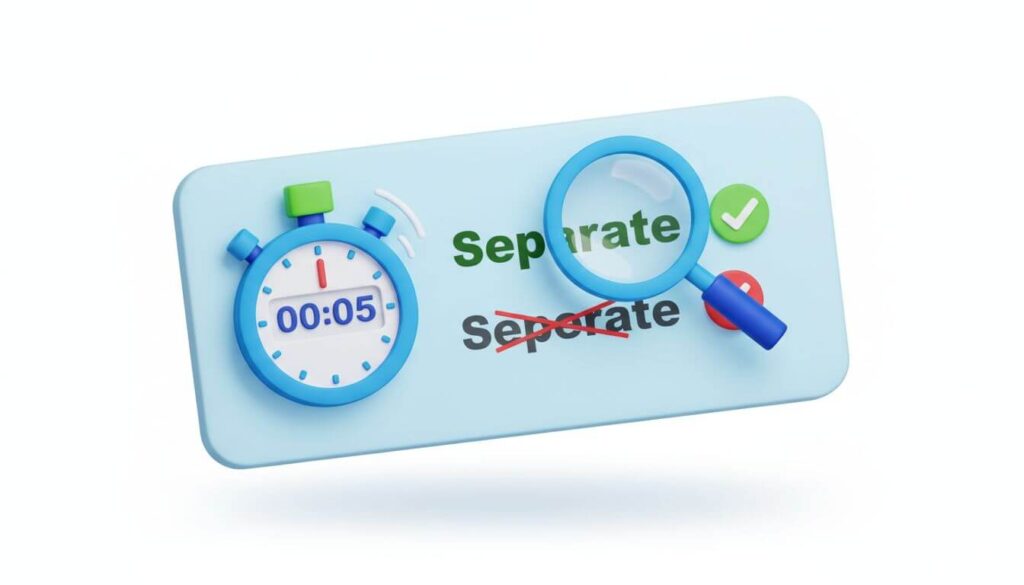
The Coaching Secret: Most students think they need to click “Yes” on every word they think they know. Wrong. Duolingo’s scoring is asymmetric. If you miss a real word, your score drops slightly. If you select a fake word (a “false positive”), your score plummets. In the 2026 version of the test, caution is a superpower.
2. Why “Read and Select” is the Gatekeeper of Your Score
Because this task happens at the start of the adaptive section, it acts as a “placement exam” within the test. If you demonstrate high spelling mastery here, the algorithm allows you to access the 140-160 point questions in the later sections. I’ve seen students improve their overall score by 15 points just by fixing their accuracy here—without learning a single new vocabulary word.
3. The Anatomy of a Fake Word: How the DET Tricks You
Duolingo doesn’t use random gibberish. They use Linguistically Plausible Nonsense. Here are the categories of fake words I’ve identified in the 2026 question bank:
Category A: The Vowel Swappers
Designed to exploit “autocorrect” in the brain. Fake: Acheive | Real: Achieve.
Category B: The Consonant Doublers
The DET preys on English spelling inconsistencies. Fake: Accomodate | Real: Accommodate.
Category C: The “Sounds-Right” Affixes
Adding real suffixes to real roots where they don’t belong. Fake: Unhappify | Real: Happy/Unhappy.
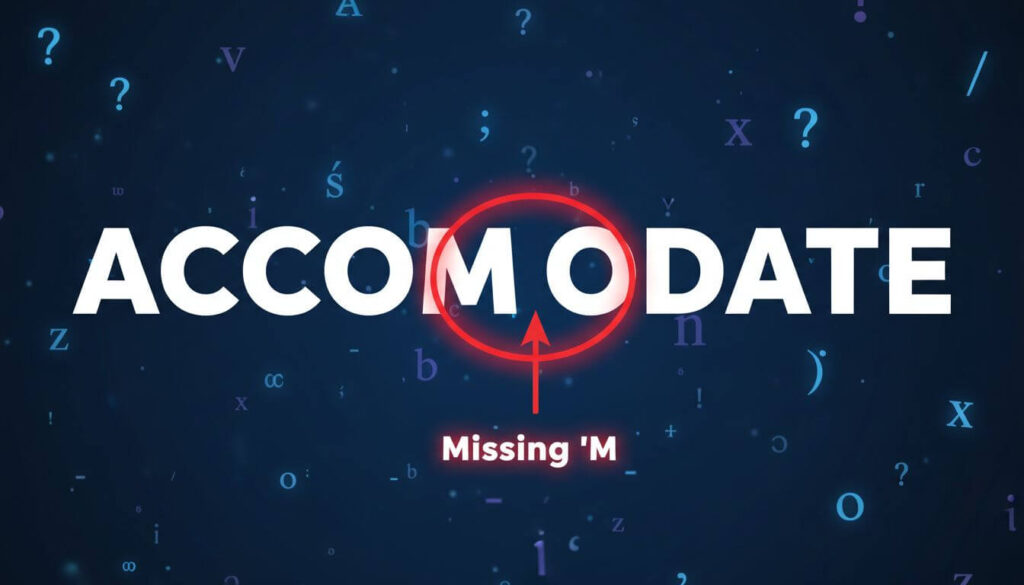
Other traps include Borrowed Word Bait (using Italian or French variations), “i before e” Violators (Fake: Wierd), and Silent Letter Erasure (Fake: Colum).
4. The 7-Step “Coach’s Method” for 5-Second Success
You need a reflex, not an analysis. Here is the routine I taught Luis to move him from a 105 to a 135:
- The “Inner Voice” Test: Read the word silently. If it feels “clunky” or doesn’t sound like something a professor would say, it’s a “No.”
- The Suffix Scan: Look at the end (-tion, -ity). If the root and suffix don’t “bond” naturally, it’s fake.
- The Double-Letter Check: Look for ‘cc’, ‘mm’, ‘ss’. If a word looks like it should have them but doesn’t, say “No.”
- The Vowel Trap Scan: Check ‘ie’ vs ‘ei’ specifically.
- The Obvious Filter: Don’t overthink simple words like house or beautiful.
- The “Foreigner” Filter: In the 2026 DET, words with accent marks are almost always real English loanwords.
- The Golden Rule: 70% sure? Say Yes. 50/50? Say No. The penalty for a wrong “Yes” is too high.
Get Professional DET Coaching
- ✓ Specialized 2026 “Read & Select” drills
- ✓ Personalized feedback on your production
- ✓ Proven templates and strategy guides
5. Case Study: Maria’s 25-Point Leap
Maria was a nurse from Colombia. She was stuck at a 115 because she was “over-reading.” She would look at occurence and think, “I know what that means,” ignoring the spelling error.

I gave her drills focused entirely on “misspelling traps.” She didn’t learn new words; she just studied the wrong versions of words she already knew. Her Literacy subscore jumped from 110 to 140, and she finished with a 135 total.
6. Your 30-Day “Orthographic Training” Plan
- Week 1: Pattern Recognition. Look at common misspellings for 10 minutes a day.
- Week 2: The 5-Second Drill. Use tools that force decisions in 5 seconds to build muscle memory.
- Week 3: The “Fake” Hunt. Read a news article and try to “misspell” 10 words like a test-maker would.
- Week 4: Full Mocks. Ensure performance doesn’t dip when you are tired.
7. The 2026 High-Yield Word List (The “Hit List”)
Study these correct spellings until you can see a missing letter from a mile away.
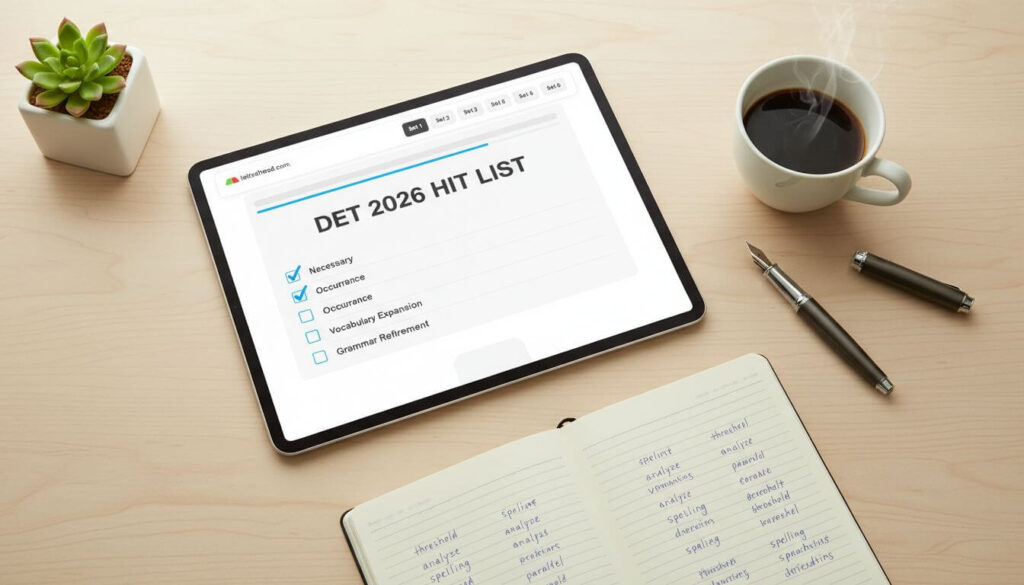
| Word | Common Fake Version | The Trap |
|---|---|---|
| Accommodate | Accomodate | Missing the second ‘m’ |
| Necessary | Neccessary | Adding an extra ‘c’ |
| Separate | Seperate | Using ‘e’ instead of ‘a’ |
| Privilege | Priveledge | Adding a ‘d’ and swapping ‘i’ for ‘e’ |
| Definitely | Definately | Using ‘ate’ instead of ‘ite’ |
| Environment | Enviroment | Missing the silent ‘n’ |
8. Why Most “AI Practice” Tools are Leading You Astray
Most free tools use simple scripts to swap letters. They generate gibberish like zxcvbnm. Students don’t fail because of gibberish—they fail because of unhappify or recieve. Our practice exercises use a database of the most common human-made spelling errors in the English language.
👉 [Access our Free Read and select DET practice exercises here]
9. FAQ: Read and Select in 2026
Does Duolingo track how fast I click?
While not explicitly stated, speed is good, but accuracy is 10x more important. Take the full 5 seconds if you need them.
I’m a native speaker. Why am I failing this?
Native speakers read “globally” (first and last letters). You must train to read “locally” (letter by letter).
If I see a word I don’t know, should I guess?
In 2026, the penalty for a “False Positive” is much higher than missing a real word. If you don’t know it, click “No.”
Ready to Master the DET?
Theory is great, but practice gets you the visa. Luis eventually mastered the “Double-Consonant Check” and got his 130. You can too. Don’t let five-second words stand between you and your future.
Start Your Practice Today
Master the Read and Select task and boost your subscores for the 2026 cycle.
Access 2026 Exercise Hub