DET for Healthcare Professionals: Your Complete Guide to English Certification for Medical Careers

I’ve spent years working with doctors, nurses, and other healthcare professionals who are navigating the complex process of international medical licensure, and one question comes up repeatedly: “Will the Duolingo English Test work for my medical license application?” The answer is increasingly yes, but there’s much more to understand about how this test fits into your professional journey.
The Duolingo English Test (DET) has become a viable alternative to traditional English proficiency exams for healthcare workers pursuing licensure and immigration opportunities. It’s more affordable, faster to schedule, and can be taken from home—all significant advantages when you’re already managing the stress of credential evaluation, board exam preparation, and possibly supporting your family through a career transition. However, understanding exactly how DET requirements align with nursing boards, medical registration bodies, and immigration processes requires specialized knowledge. This guide will walk you through everything you need to know about using DET for your healthcare career advancement, whether you’re a nurse preparing for NCLEX, a physician working toward USMLE, or any medical professional planning to practice in an English-speaking country.
DET for Nurses Seeking US Licensure
DET Score Requirements for Nurses
When you’re pursuing nursing licensure in the United States, understanding the English proficiency requirements can feel overwhelming, especially since different states maintain their own nursing boards with varying standards. Most state boards require you to demonstrate English proficiency through one of several accepted tests, and an increasing number now accept the DET. The typical DET score requirement for nursing licensure ranges from 105 to 120 overall, though this varies by state. California’s Board of Registered Nursing, for instance, accepts DET scores of 120 or higher as proof of English proficiency. New York State requires similar scores, while some other states may accept scores as low as 105. What makes this particularly important is that you need to verify your specific state’s requirements directly with their nursing board, as these standards can change.
Beyond the overall score, many boards look at your subscores in literacy, conversation, comprehension, and production. Nursing requires strong communication skills across all these areas because you’ll be reading medical charts, documenting patient care, speaking with doctors and patients, and understanding complex verbal instructions during emergencies. A score of 110 in literacy but only 90 in conversation could raise concerns, even if your overall score meets the minimum. State boards want to see balanced competency because patient safety depends on your ability to communicate clearly in high-pressure situations. The CGFNS (Commission on Graduates of Foreign Nursing Schools) also plays a crucial role here. If you’re going through the VisaScreen process for immigration purposes, CGFNS evaluates your English proficiency test results. They currently accept DET scores, which has made the immigration pathway significantly more accessible for nurses who find traditional testing centers difficult to reach or afford.

NCLEX and DET Requirements
Here’s something many internationally educated nurses don’t realize initially: the NCLEX exam itself doesn’t test English proficiency—it tests nursing knowledge. However, you must prove English proficiency before you’re even eligible to sit for the NCLEX. This is where DET comes into your licensing timeline. The process typically works like this: First, you submit your educational credentials to your chosen state’s board of nursing or through CGFNS. Second, you demonstrate English proficiency through an accepted test like DET. Third, you receive authorization to test (ATT) for NCLEX. Fourth, you pass NCLEX and receive your nursing license. Many nurses make the mistake of thinking they can take NCLEX first and worry about English requirements later, but the boards are strict about this sequence.
When you’re preparing for both DET and NCLEX simultaneously—and let’s be honest, most nurses do exactly this to save time—you’ll notice that strong English skills directly improve your NCLEX performance. The NCLEX questions are complex, with detailed patient scenarios that require careful reading comprehension. If English isn’t your first language, you might read a question three times before fully understanding what it’s asking. Preparing for DET actually helps your NCLEX preparation because you’re strengthening the same language skills you’ll need to interpret those tricky test questions. State boards also care about how recently you took your English proficiency test. Most boards accept DET scores that are less than two years old, though some extend this to three years. If your DET results are older, you may need to retake the test, which is frustrating but necessary. Plan your testing timeline carefully, especially if you’re dealing with credential evaluation delays or if you need to complete additional nursing coursework before becoming eligible for NCLEX.
DET for Doctors Medical Registration
DET for Specific Medical Boards
Medical registration for international medical graduates involves multiple layers of requirements, and English proficiency sits at the foundation of this process. The ECFMG (Educational Commission for Foreign Medical Graduates) is your gateway to USMLE Step 2 Clinical Skills assessment and eventually to residency programs. As of recent years, ECFMG has accepted DET as proof of English proficiency, which represents a significant shift in accessibility for international medical graduates. For ECFMG certification, you need a DET score of at least 120 overall, with no subscore below 105. This is notably higher than nursing requirements, and for good reason—physicians must communicate complex medical concepts, lead healthcare teams, obtain informed consent, and explain treatment plans to patients with varying levels of health literacy. A misunderstood medication instruction or an unclear discharge summary can have serious consequences.
State medical boards add another layer of requirements. If you’re planning to practice in a specific state, that state’s medical board will review your credentials independently, even after you’ve satisfied ECFMG requirements. Texas, Florida, California, and New York—states with large populations of international medical graduates—each maintain their own English proficiency standards. Some accept your ECFMG certification as sufficient proof, while others require separate documentation. I’ve worked with physicians who satisfied federal requirements but then faced additional state-level English testing, which delayed their licensure by months. Medical specialty boards sometimes have their own language considerations too. If you’re pursuing board certification in a specialty like psychiatry, where communication is absolutely central to patient care, demonstrating exceptional English proficiency becomes even more critical. While the DET score requirements don’t change, your practical language abilities will be scrutinized during residency interviews and clinical rotations.
Medical Specialty Vocabulary Focus
One challenge I see doctors face with DET is that the test doesn’t specifically evaluate medical vocabulary. You won’t encounter questions about pharmacology terms or anatomical structures. Instead, DET assesses general English proficiency, which can feel disconnected from your actual professional needs. However, this actually works in your favor if you approach preparation strategically. Strong general English skills provide the foundation, and you already possess extensive medical vocabulary from your training. What you need to develop is the ability to explain medical concepts in plain language—a skill that’s crucial for patient communication anyway. During DET’s speaking sections, you might need to describe an image or respond to a prompt that isn’t medical. Your ability to articulate clearly and naturally in English, regardless of the topic, demonstrates the language flexibility that medical practice requires.
That said, building your medical vocabulary in English remains essential for your actual clinical practice and for USMLE preparation. Terms like “myocardial infarction” versus “heart attack,” understanding when to use “hypertension” versus “high blood pressure,” and knowing abbreviations like NPO, PRN, and STAT in their proper context—these become critical once you enter clinical settings. While DET won’t directly test these terms, your broader English proficiency affects how quickly you can absorb and use this specialized vocabulary. Doctors also need to master the language of medical documentation. Progress notes, discharge summaries, and consultation reports follow specific formats and use particular language patterns. Phrases like “patient presents with,” “differential diagnosis includes,” and “plan is to” become second nature in English-language healthcare systems. Your DET preparation, particularly in the writing sections, should help you develop the clear, concise writing style that medical documentation requires.
Achieve the Score YourProfession Demands
- ✓ Master the English needed for patient communication
- ✓ Practice with mock tests that simulate the real exam
- ✓ Get expert feedback tailored to healthcare professionals
Prepare for licensure with confidence!
DET for Healthcare Worker Immigration
DET Preparation for Medical Professionals
Preparing for DET as a healthcare professional requires a different approach than preparing for academic purposes. You’re not just trying to prove you can study at a university—you’re demonstrating that you can function safely and effectively in a healthcare environment where language mistakes can affect patient outcomes. Start by understanding DET’s format: it’s an adaptive test taken on your computer, lasting about one hour, with sections covering reading, writing, listening, and speaking. Unlike IELTS or TOEFL, which have fixed question types you can memorize, DET adapts in real-time to your performance. Answer questions correctly, and the test becomes more difficult; make mistakes, and it adjusts downward. This means you can’t rely solely on test-taking strategies—you need genuine English proficiency.
For reading comprehension, practice with materials beyond medical textbooks. Read English-language news articles, healthcare policy discussions, and patient education materials. Healthcare professionals often struggle with idiomatic expressions and cultural references that appear in general English contexts. A phrase like “under the weather” is obvious to native speakers but might confuse someone who learned English in formal medical settings. DET includes these everyday expressions, so broadening your reading habits pays off. Listening skills present a particular challenge because DET uses various English accents—American, British, Australian, and others. In your future medical practice, you’ll encounter patients and colleagues from diverse backgrounds, so this variety is actually relevant. Practice listening to medical podcasts, TED talks about health topics, and even TV medical dramas in English. Pay attention to how people with different accents pronounce common words and medical terms differently.
The speaking sections of DET require you to respond clearly and naturally within time limits. Healthcare professionals sometimes overthink their responses, trying to use overly formal language. Remember, effective communication means speaking clearly and naturally, not using the most complex vocabulary possible. Practice describing your daily work routines, explaining medical procedures in simple terms, and sharing your professional experiences. Record yourself speaking and listen back—you’ll notice patterns in your speech that need improvement. Writing preparation should focus on clarity and organization. DET’s writing prompts might ask you to describe an image, respond to a question, or write about a topic. While you won’t be writing medical case reports, the skills transfer directly. Practice writing clear, well-organized responses within time limits. Many healthcare professionals write excellent technical reports but struggle with informal writing tasks, so this practice is valuable.
Patient Communication Scenarios

Here’s something crucial that many medical professionals overlook: your English proficiency test score is just the minimum threshold. What really matters is your ability to communicate effectively with patients, and this requires skills beyond what any test measures directly. Patient communication in English-speaking healthcare systems differs significantly from what you might be used to. American patients, in particular, expect healthcare providers to use plain language, show empathy, and involve them in decision-making. You might be accustomed to a more directive communication style where doctors tell patients what to do, but in the US, you’ll need to explain options, discuss risks and benefits, and respect patient autonomy.
Common patient communication scenarios include taking medical histories, explaining diagnoses, discussing treatment options, and providing discharge instructions. Each requires specific language patterns. For example, when taking a medical history, you need open-ended questions like “Tell me about your pain” followed by specific questions like “Does anything make it better or worse?” You need to understand when patients use informal language—they might say “my sugar” instead of “blood glucose” or “my pressure” instead of “blood pressure.” Explaining medical conditions requires simplifying complex concepts without being condescending. If you diagnose pneumonia, can you explain it as “an infection in your lungs that makes breathing difficult and causes cough and fever” rather than using technical terms the patient won’t understand? Can you then explain treatment in terms that make sense: “We’ll give you antibiotics—medicine that fights the infection—through your IV for a few days, then you’ll switch to pills at home”?
Cultural competence intersects with language skills in patient communication. Understanding when to make eye contact, how to address elderly patients respectfully, and how to discuss sensitive topics like end-of-life care all require both language proficiency and cultural awareness. Your DET score proves you have basic English skills, but developing this deeper communication competence happens through practice, observation, and feedback from colleagues.
DET Medical Vocabulary Preparation
DET Healthcare Vocabulary List
While DET doesn’t include specific medical vocabulary sections, building your healthcare English vocabulary strengthens your overall language proficiency and prepares you for clinical practice. Medical English encompasses several categories that healthcare professionals must master. Basic medical terminology includes anatomical terms (abdomen, thorax, extremities), common symptoms (nausea, dyspnea, fatigue), and frequent conditions (diabetes, hypertension, asthma). You should know both the formal medical terms and the plain language equivalents that patients use. For instance, “myalgia” is muscle pain, “epistaxis” is a nosebleed, and “vertigo” is dizziness, though patients rarely use these formal terms.
Pharmacology vocabulary is essential for prescribing and patient education. You need to understand medication classes (antibiotics, antihypertensives, analgesics), administration routes (oral, intravenous, topical), and dosing terms (twice daily, every six hours, as needed). Common abbreviations like PO (by mouth), IV (intravenous), PRN (as needed), and BID (twice daily) appear constantly in medical orders and documentation. Procedural language covers common tests and treatments. Can you explain what a chest X-ray, CT scan, or MRI involves? Can you describe procedures like intubation, catheterization, or wound debridement in ways that both colleagues and patients understand? Healthcare workers need this dual capability—technical precision with colleagues and clear simplicity with patients.
Documentation vocabulary includes words and phrases used in medical records. Terms like “unremarkable” (which means normal, not unimportant), “within normal limits,” “significant for,” and “negative for” have specific meanings in medical contexts. Understanding these terms helps you read charts effectively and write clear documentation. Hospital and clinical environment vocabulary covers daily healthcare settings: emergency department, intensive care unit, outpatient clinic, operating room, pharmacy, radiology department. You’ll also need words for medical equipment: stethoscope, blood pressure cuff, thermometer, pulse oximeter, defibrillator, ventilator, infusion pump.
Healthcare Documentation Language
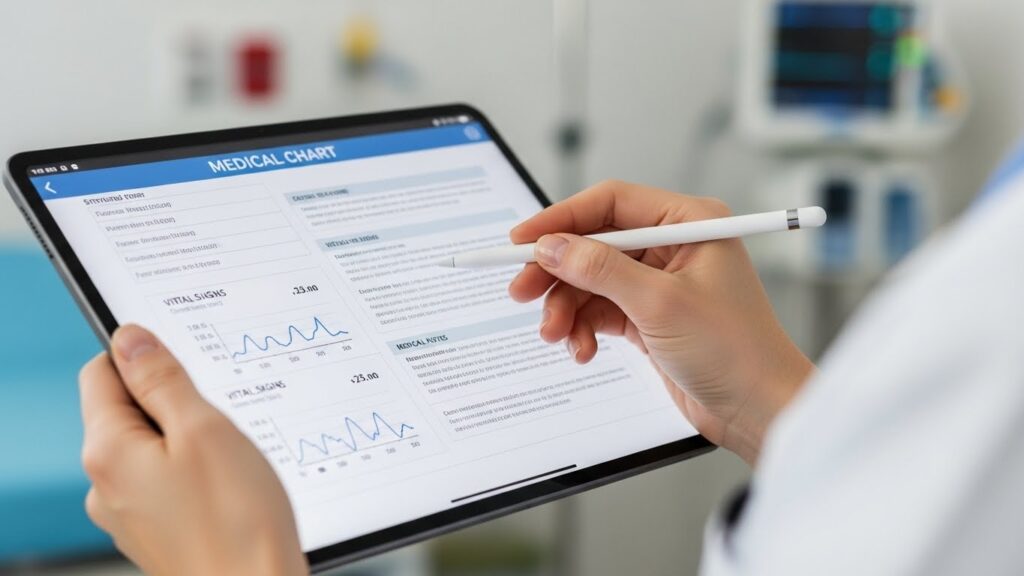
Medical documentation in English-speaking countries follows specific conventions that differ from documentation styles in other healthcare systems. Understanding these patterns is crucial for your professional success, even though DET doesn’t directly test them. SOAP notes (Subjective, Objective, Assessment, Plan) represent the standard format for clinical documentation in many settings. The subjective section includes patient complaints in their own words: “Patient reports chest pain that started three hours ago, describes it as crushing, radiating to left arm.” The objective section contains measurable findings: “Blood pressure 160/95, heart rate 110, respiratory rate 22.” The assessment synthesizes information: “Likely acute coronary syndrome based on presentation and risk factors.” The plan outlines next steps: “Obtain EKG, troponin levels, aspirin 325mg given, cardiology consultation requested.”
Admission notes, progress notes, and discharge summaries each have specific formats and language patterns. Admission notes are comprehensive, covering full medical history, physical examination, differential diagnosis, and treatment plan. Progress notes are briefer, focusing on changes in patient status and treatment adjustments. Discharge summaries include hospital course, final diagnoses, medications prescribed, and follow-up instructions. Precision in documentation language is critical because medical records serve legal, clinical, and billing purposes. Vague phrases like “patient feels better” don’t convey useful information, while specific statements like “patient reports pain decreased from 8/10 to 3/10 after medication” provide clear, measurable information. Similarly, “patient appears uncomfortable” is less useful than “patient grimacing, guarding abdomen, vital signs stable.”
Understanding the difference between subjective and objective language matters. “Patient is anxious” mixes observation with interpretation, while “patient states feeling anxious, noted trembling hands and rapid speech” provides observable facts. This precision protects you legally and ensures clear communication with other healthcare providers. Abbreviations appear extensively in medical documentation, but you must use them correctly and know when to avoid them. High-alert abbreviations like “U” (for units) or “QD” (daily) are banned in many institutions because they’ve caused medication errors. Understanding facility-specific policies on abbreviations is part of safe documentation practice.
Frequently Asked Questions
What DET score do I need for USMLE?
For USMLE and ECFMG certification, you need a DET score of at least 120 overall with no subscore below 105. This requirement ensures you have sufficient English proficiency to communicate with patients, understand complex medical concepts in English, and participate effectively in clinical rotations during residency. The ECFMG reviews your DET score as part of their certification process, which you must complete before you can enter residency training programs in the United States. Keep in mind that individual residency programs may have their own preferences, and some competitive programs expect higher English proficiency even though they don’t set formal requirements beyond ECFMG standards.
Is DET accepted for nursing license applications?
Yes, many state nursing boards now accept DET as proof of English proficiency for licensure. However, acceptance varies by state, so you must verify requirements with your specific state board of nursing. States like California, New York, Florida, and Texas have clear policies on DET acceptance, typically requiring scores between 105 and 120. If you’re pursuing nursing licensure for immigration purposes through the VisaScreen process, CGFNS also accepts DET scores. Always check the most current requirements directly with your state board because policies evolve, and you want to ensure your test results will be accepted before you invest time and money in preparation.
How should I prepare for DET as a doctor?
Preparation should combine general English skill development with awareness of your specific professional needs. Start by taking a DET practice test to identify your weak areas. Focus your preparation on improving those specific skills rather than trying to study everything at once. Practice reading diverse English materials beyond medical journals—news articles, opinion pieces, and literature will expose you to vocabulary and grammar patterns that appear on DET. For listening practice, use podcasts, TED talks, and medical lectures in English. Develop your speaking skills by practicing responses to general topics, recording yourself, and self-evaluating for clarity, fluency, and pronunciation. Writing practice should emphasize organizing ideas clearly and expressing them concisely within time limits. Most importantly, use English actively in your daily life as much as possible—this builds the natural fluency that DET’s adaptive format is designed to measure.
What medical terms appear in the DET?
DET doesn’t include specific medical terminology because it tests general English proficiency rather than specialized vocabulary. You won’t encounter questions about anatomy, pharmacology, or medical procedures. Instead, the test evaluates your ability to understand and use English across everyday contexts. However, the strong general English skills that DET measures directly support your ability to learn and use medical vocabulary effectively. Once you’re working in an English-speaking healthcare environment, you’ll encounter extensive medical terminology, but your foundation in general English will help you absorb this specialized language quickly. Focus your DET preparation on broad English proficiency, and separately study medical vocabulary for your clinical practice and board examinations.
Conclusion
Navigating English proficiency requirements while pursuing medical licensure or nursing certification can feel overwhelming, but understanding how DET fits into your professional pathway makes the process more manageable. Whether you’re a nurse working toward NCLEX, a physician pursuing USMLE and ECFMG certification, or any healthcare professional planning to practice in an English-speaking country, DET offers an accessible, efficient way to demonstrate your language proficiency. Remember that your DET score is a starting point, not the finish line. The real goal is developing the communication skills you’ll need throughout your healthcare career—explaining complex medical concepts to patients, collaborating with multidisciplinary teams, documenting care accurately, and continuously learning in a language that might not be your first. These skills take time to develop, but with focused preparation and genuine engagement with English in professional contexts, you’ll build the proficiency you need.
Your medical expertise is valuable, and language barriers shouldn’t prevent you from practicing your profession and serving patients who need your skills. Take preparation seriously, understand the specific requirements for your intended career path, and remember that thousands of healthcare professionals have successfully navigated this same journey. Your dedication to learning English proficiency requirements shows the same commitment to excellence that makes you a capable healthcare provider. With the right preparation and persistence, you’ll achieve the scores you need and move forward in your medical career.
Advance Your Medical Career Today
You have the medical expertise. We have the English preparation you need to meet licensure requirements. Get started with our specialized courses for healthcare professionals.
View Healthcare Courses