TestGlider vs. Teacher Leda: Is AI-Powered Mock Testing Enough for DET 140+?

Quick Summary
Taking endless mock tests on platforms like TestGlider builds stamina, but it won’t fix your underlying weaknesses. This guide breaks down the danger of the “mock test trap” and explains why combining AI tools with human diagnostics and targeted strategy is the most efficient way to break through a score plateau and reach a 130 or 140+.
Table of Contents
Picture this: a student — let’s call her Priya — has been preparing for the Duolingo English Test for three months. She’s taken eleven mock tests on TestGlider. Her score sits at 110. It has sat at 110 for six weeks. Every weekend she takes another test. She reviews the results page. She sees the same breakdown. She takes another test.
This is one of the most common patterns I’ve seen in DET preparation. Students discover TestGlider, which is genuinely one of the better mock testing platforms available, and they start grinding. They treat mock tests the way a runner treats miles — more must mean better. But language proficiency doesn’t work like marathon training. Volume alone doesn’t create growth.
TestGlider offers real value. That’s worth saying upfront. But is AI-powered mock testing, by itself, enough to push you past DET 130 or 140? That’s the real question this article answers. If you’re plateauing on mock tests — or you’re just starting out and want to invest your prep time wisely — keep reading.
TestGlider’s Strengths
Before getting critical, let’s be fair. TestGlider does several things genuinely well, and if you haven’t explored it yet, you should understand what you’re getting.
Full-Length Mock Tests Under Timed Conditions
This is TestGlider’s biggest asset. The platform simulates the actual DET format reasonably well — the time pressure, the rapid task-switching, the mix of production and receptive tasks. For students who have never sat through a full adaptive test before, this is valuable exposure.
The test conditions matter. Timing yourself at home with a YouTube video is not the same thing as sitting through a structured, locked-environment simulation. TestGlider creates enough pressure to make the experience feel somewhat real. Your stamina, your pacing, your ability to handle task variety — you can genuinely practice these things here. That’s not nothing.
Performance Analytics Dashboard
After each mock test, TestGlider generates a breakdown of your estimated subscores — Literacy, Comprehension, Conversation, and Production. You can track your score history across tests, identify which areas dipped, and see rough performance trends over time.
For students who are data-oriented, this dashboard is satisfying to look at. You can see progress (or lack of it) visually. Some students find this motivating. Others find it quietly devastating when the chart flatlines for weeks.
Here’s what the dashboard does well: it tells you what is happening. Your Literacy subscore is lower than your Conversation score. Your Production estimate dropped two points since last week. These are real observations.
Here’s what it doesn’t do: it doesn’t tell you why. And that gap — between what and why — is where most students lose months of their lives.
Community Discussion Features
TestGlider has a community element where students share experiences, discuss test formats, and sometimes post about their real exam scores compared to their mock scores. This is genuinely useful social proof. You can gauge whether the platform’s score estimates are trending close to real DET results, or whether there’s a consistent gap.
The community feedback is mixed, which is honest. Some students report TestGlider scores that are within five to ten points of their real results. Others report gaps of fifteen to twenty points in either direction. This variance tells you something important about the limits of any mock platform — but we’ll come back to that.
Where TestGlider Falls Short
This is the part of the article that will either save you several months or make you defensive. I understand if it’s the latter. Nobody wants to hear that the preparation system they’ve been trusting has a fundamental structural flaw.
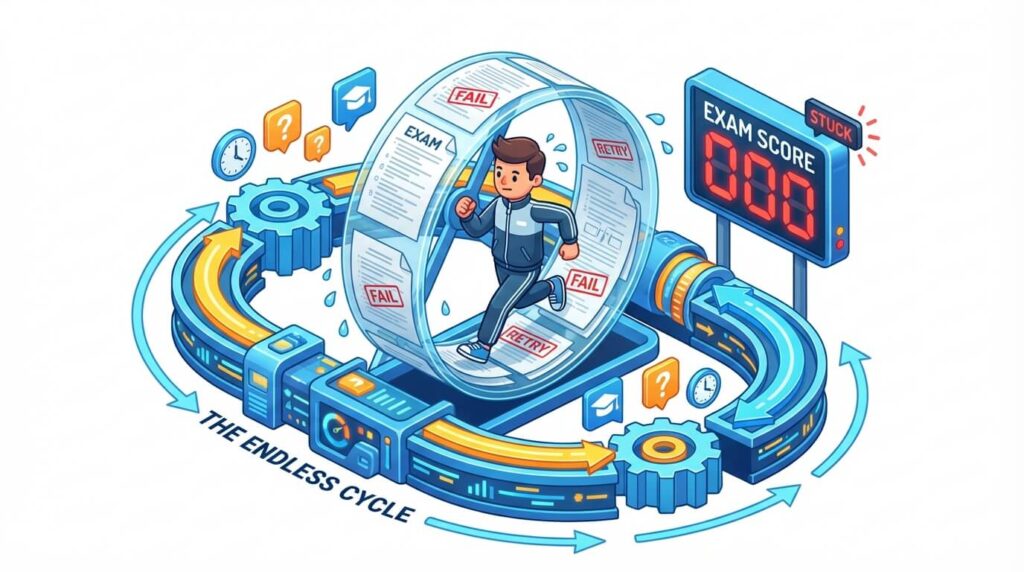
The “Mock Test Trap”: Practice Without Strategy
The mock test trap is simple. You take a test. You get a score. The score feels close to your goal but not quite there. You assume more practice will close the gap. You take another test. Same score. Or sometimes it goes up by five points, which feels like progress, then comes back down the next week, which feels inexplicable.
What’s actually happening is this: you’re measuring your current level repeatedly without doing anything to change it. A mock test is a diagnostic tool. It is not a learning tool. These are completely different things, and TestGlider’s design — which is built around test-taking — blurs that distinction by putting the testing experience front and center.
When you sit down to study, the most natural thing on TestGlider is to take another test. The platform isn’t designed to stop you. It will happily let you take fifteen tests in a row and send you a beautiful analytics chart of your plateau.
Sound familiar?
Generic Feedback That Doesn’t Address Root Causes
After each mock, TestGlider gives you subscore estimates and some general performance notes. What it cannot do — what no AI mock platform currently can do — is tell you the specific linguistic reason your Writing subscore is stuck at 85.
Is it your use of cohesive devices? Are your sentences structurally correct but semantically thin? Are you losing points on the Read and Complete tasks because you’re guessing on collocations? Is your spoken response in the Speak About the Photo section falling short because of pronunciation, fluency, or content organization?
TestGlider’s analytics cannot answer these questions. It can tell you that your Production score is lower than your Literacy score. What to actually do about that — that requires a human who understands both the scoring rubric and your specific English background.
Here’s what TestGlider won’t tell you: two students with identical overall scores of 110 can have completely different underlying weaknesses. The same number means different things. The fix for one student has nothing to do with the fix for the other. Generic feedback applied to both of them will help neither.
Case Study: The Student Who Took 15 Mock Tests and Scored the Same Every Time
Let me tell you about Marcus, a Brazilian student who came to Teacher Leda after four months on TestGlider. He was targeting DET 125 for a university application in Canada. He had taken fifteen full mock tests. His score had ranged from 105 to 115, with most results clustering around 108–112.
Marcus was frustrated, but he wasn’t giving up. He believed he just needed more practice. “I thought maybe I was having bad test days,” he told me later. “I figured if I kept going, something would click.”
Nothing clicked.
When Marcus did the free diagnostic with Teacher Leda, two things became immediately clear. First, his Reading and Listening comprehension was actually quite solid — sitting around 120-equivalent. Second, his Writing production was dragging everything down. Specifically, Marcus was writing responses that were grammatically correct at the sentence level but completely disconnected at the paragraph level. He had no control over discourse structure. His sentences didn’t build on each other. His responses felt like a list of observations rather than a coherent argument.
TestGlider had told Marcus, repeatedly, that his Literacy subscore was lower than his Comprehension subscore. It had never explained why, and more importantly, it had never offered a way to fix it.
Within six weeks of targeted work on discourse coherence and response architecture, Marcus scored 128 on the real DET. He went from four months of plateauing at 110 to hitting his target in six weeks. The mock tests hadn’t been wrong. They just hadn’t been useful.
I’ve watched this happen dozens of times. The platform isn’t the problem. The strategy is.
Teacher Leda’s Strategic Approach
Explore Teacher Leda’s main services here. The fundamental difference between TestGlider and Teacher Leda isn’t really about AI versus humans. It’s about the difference between measuring a problem and solving it.

Diagnosis Before Practice: Finding Your Leaks
Teacher Leda’s process starts with a diagnostic session, not a mock test. This is intentional and important. Before you practice anything, you need to understand what you actually need to practice. Sounds obvious. Almost no one does it.
The diagnostic looks at your performance across task types, asks you targeted questions about your English background, and identifies patterns that mock test scores simply cannot surface. Have you been living in an English-speaking environment? What’s your L1? What does your written English look like when you’re not under test pressure? These questions change everything about how preparation should be structured.
Most students who come to Teacher Leda after months on TestGlider have been practicing the wrong things. Not because they’re not working hard — they usually are — but because they’ve been guided by a number rather than by a diagnosis.
Targeted Drills, Not Endless Tests
Once the leaks are identified, the work shifts to targeted drilling on specific sub-skills. This might mean intensive work on Read Aloud tasks with focus on prosody. It might mean rebuilding the way a student structures written arguments. It might mean nothing to do with grammar at all — maybe the student’s vocabulary range is limiting them in ways they haven’t connected to their score.
The key word is targeted. Not more tests. Not more exposure. Specific, deliberate practice on the exact skills that are holding the score back. This is a fundamentally different use of preparation time than taking another full mock exam.
The 80/20 Rule: What Actually Moves Your Score
Here’s the honest truth about DET preparation: most students have two or three specific weaknesses that are responsible for most of their score gap. Fix those, and the score moves significantly. Everything else is marginal.
TestGlider’s model treats all tasks equally because it has to — it’s a testing platform. Teacher Leda’s model is built around finding those two or three things as quickly as possible and attacking them directly. That’s the 80/20 rule in practice. Twenty percent of the right work drives eighty percent of the score improvement.
This doesn’t mean preparation is easy or fast. It means it’s efficient. And for students with application deadlines, efficiency is not a nice-to-have. It’s the whole game.
Stop Testing.Start Improving.
- ✓ Get a human diagnostic on your speaking & writing
- ✓ Find the exact root cause of your plateau
- ✓ Targeted, efficient strategies to hit 130+
Custom strategies tailored for you!
Head-to-Head Comparison
Test Quality vs. Strategy Quality
| Criterion | TestGlider | Teacher Leda |
|---|---|---|
| Format Accuracy | Good — closely mimics DET task types and timing | Not applicable — focuses on skill-building, not test simulation |
| Feedback Depth | Surface-level — subscore estimates, no linguistic analysis | Deep — specific, task-level feedback with explanation |
| Root Cause Analysis | None — identifies gaps but not causes | Core feature — diagnosis is built into the process |
| Strategy Adaptation | None — same test format every time | Dynamic — approach evolves as gaps close |
| Score Predictability | Moderate — community reports 5–20 point variance | Higher — outcome-based coaching with score targets |
The table above makes something clear: these tools aren’t really competing for the same job. TestGlider simulates the test. Teacher Leda prepares you to perform better on it. If you’re using TestGlider as your primary preparation method, you’re using a measurement tool as a teaching tool. That’s the category error that causes plateaus.

Time Efficiency: Hours Spent vs. Points Gained
A full TestGlider mock test takes approximately 45–60 minutes. Add another 20–30 minutes for reviewing the analytics. Call it 90 minutes per test cycle. Fifteen test cycles (like Marcus) equals roughly 22 hours of study time.
Marcus’s score after 22 hours on TestGlider: plateaued at 110.
After six weeks with Teacher Leda — roughly 8–10 hours of targeted coaching plus structured drills between sessions — he hit 128.
That’s not a criticism of TestGlider specifically. It’s a structural observation about what different types of preparation do to your time. Mock tests consume time. Targeted coaching converts time into score gains. The difference matters a lot when you have a deadline.
Cost Analysis: Subscription vs. Outcome-Based Pricing
Let’s put real numbers on this.
TestGlider pricing (approximate): ~$29/month or ~$199/year. For a student studying for six months, that’s roughly $174 at the monthly rate.
Teacher Leda pricing (approximate): $49/hour for individual sessions; $129 for the Accelerator package; $349 for the full Mastery program.
At first glance, TestGlider looks dramatically cheaper. But let’s factor in outcomes.
If you spend six months on TestGlider, pay $174, and your score moves from 105 to 115 — a gain of 10 points — your cost per point is about $17.40.
If you spend six weeks with Teacher Leda’s Accelerator program ($129), work between sessions with targeted drills, and move from 105 to 128 — a gain of 23 points — your cost per point is about $5.60.
Suddenly the “cheaper” option isn’t cheaper at all. It’s three times more expensive per point gained. And that’s before accounting for the opportunity cost of the months you’ve spent not improving. The real cost of the mock test trap isn’t the subscription fee. It’s the time.
When TestGlider Makes Sense
I want to be fair here, because TestGlider is a legitimate tool used incorrectly by most of its users. There are real scenarios where it adds genuine value.
For Students Already Scoring 130+ Needing Stamina
If your underlying English skills are at or near your target level — meaning a human coach or strong diagnostic has confirmed this — then stamina and test familiarity are legitimate limiters. A student who scores 130 on targeted practice tasks but underperforms on full-length tests due to fatigue or anxiety can benefit from regular mock exam exposure.
TestGlider’s timed, full-format tests are well-suited for this specific use case. At this level, you’re not trying to fix fundamental skill gaps. You’re trying to perform consistently under pressure. That’s a different problem, and TestGlider is a reasonable tool for it.
As a Supplement to Human Coaching
The ideal use of TestGlider is exactly this: as a reality-check tool during a structured coaching program. After several weeks of targeted skill work, a mock test can confirm whether the improvements are showing up under test conditions. It adds useful context to the coaching process.
Teacher Leda recommends this approach directly — a mock test every two to three weeks as a progress check, not as the primary mode of study.
The Limits Even in Those Cases
Even in the scenarios above, TestGlider’s feedback loop has limits. The score variance between mock results and real DET outcomes is real enough that students should treat mock scores as approximate ranges, not precise predictions. Students who’ve scored 130 on TestGlider have taken the real DET and seen 115. Students who’ve scored 120 have seen 135.
Don’t let a strong mock result give you false confidence. And don’t let a weak one crush your momentum. Use the data directionally, not definitively.
Making the Switch

From TestGlider to Teacher Leda: What Changes
The shift isn’t as dramatic as it might sound. You don’t throw out everything you’ve learned from mock testing. What changes is the orientation of your preparation.
Instead of beginning each study session by taking a test and reacting to the results, you begin with a specific skill target. You practice that skill deliberately. Occasionally you test yourself to check that it’s transferring. The mock test becomes a tool in a larger system, not the system itself.
Students who make this switch consistently describe the same experience: the first few weeks feel slower because you’re working on specifics rather than generating scores. Then, somewhere around weeks three to four, something clicks. The score on the next mock test jumps. Not by two points. By ten or fifteen. That jump isn’t magic. It’s what happens when the underlying skill actually improves.
Special Offer for TestGlider Users
If you’ve been using TestGlider and you’re reading this because you’re frustrated — that’s not an accident. Students who are growing don’t search for alternatives. Students who are stuck do.
The good news is that being stuck on TestGlider is actually useful information. It means you have a real, identifiable plateau. Plateaus have causes. Causes can be found and fixed. You’re not in a worse position than someone who’s never studied — you just need a diagnostic to tell you where the work actually needs to happen.
Teacher Leda offers a structured onboarding that includes review of your TestGlider history. Your mock test data is a starting point, not wasted time. Review Teacher Leda’s main services here.
Free Diagnostic to Identify Your Real Gaps
The most direct next step is the free diagnostic. This isn’t a sales call. It’s a structured assessment of your specific performance profile — looking at the areas TestGlider can measure and several it can’t. Within one session, you’ll know what’s actually holding your score back.
Most students who do the diagnostic describe it as the first time they’ve had a clear picture of their preparation. After months of staring at a score, having someone explain exactly why it’s where it is — and what would actually change it — feels like a considerable relief.
⚡ Quick Verdict
Choose TestGlider if: You’re already at 130+ and need stamina practice, or you want a supplemental check-in tool during a structured coaching program.
Choose Teacher Leda if: You’ve been stuck at the same score for more than three to four weeks, you’ve taken more than five mock tests without meaningful progress, or you need to reach 125+ within a specific deadline.
Use both if: You’re in active coaching and want occasional full-format practice to confirm your skill gains are transferring.
Frequently Asked Questions
Are TestGlider’s mock tests similar to the real DET?
The format is reasonably similar — TestGlider replicates most of the DET task types, and the timed conditions feel comparable. Where it diverges is in the adaptive algorithm. The real DET adjusts difficulty dynamically based on your responses, which affects both what you see and how your performance is scored. TestGlider’s adaptive logic is an approximation of this, not a replica. The scoring model is also calibrated independently, which is why community-reported score gaps between mock and real results can be significant — sometimes five points, sometimes twenty. Use TestGlider scores as a directional range, not a precise prediction of your actual DET outcome.
How many mock tests should I take before the real exam?
Somewhere between three and five, spaced strategically. That’s it. I know that’s not what most TestGlider users are doing, but more tests without targeted study in between is genuinely counterproductive. Each additional mock test without skill-building in between just confirms your current level. Worse, it can normalize your plateau — you start to believe that 110 is just what you score, rather than understanding it as a problem to solve. Three to five high-quality mock tests, with deliberate focused study between each one, will do far more for your score than fifteen tests taken back to back. The goal is to use each test as a diagnostic for the next round of targeted practice, not as an end in itself.
Can Teacher Leda review my TestGlider results?
Yes, and this is actually one of the more efficient ways to start the coaching process. Your TestGlider history — subscore patterns, the tasks where your performance dips most consistently, how your scores have moved over time — provides useful raw material for the diagnostic. What the diagnostic adds is the interpretation layer that TestGlider’s analytics can’t provide: the why behind the pattern. A student whose Literacy subscore has been consistently five points below their Comprehension score across twelve tests has told us something. The diagnostic turns that observation into an action plan. Bring your TestGlider data. It’s not wasted — it’s a head start.
Preparing for the DET and want to know exactly where your score gap is coming from? Start with the free diagnostic.
Break Your Test Score Plateau
Ready to move from endless mock tests to strategic, targeted skill building? Explore Teacher Leda’s preparation courses today.
Explore Preparation Courses